
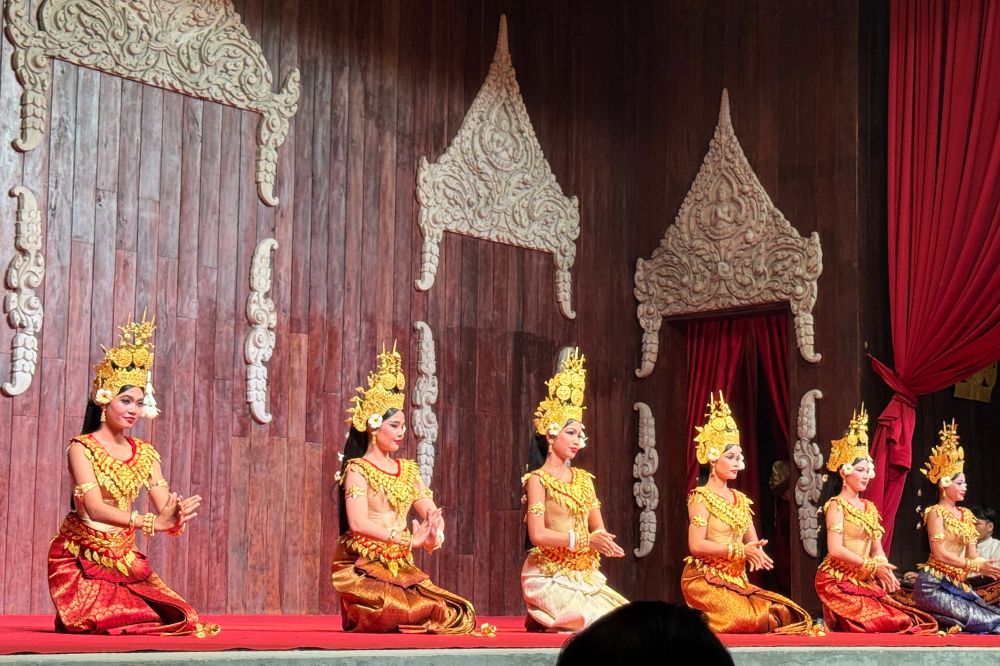
Her head is crowned with a golden, multi-tiered spired tiara (Mokot) that glints with every subtle tilt of her neck. Her bare feet press against the stage with deliberate, grounded weight, while her hands—fingers hyper-extended backward in impossibly fluid curves—tell a story without uttering a single word.
If you have spent your morning wandering through the stone corridors of Angkor Wat, those hands will look instantly familiar. You have seen them carved thousands of times into the bas-reliefs of sandstone galleries, frozen mid-motion for nearly a millennium.
At CWE Travel, we believe that visiting the temples is only half the story. To truly unlock the magic of the Khmer Empire, you must see those stone carvings come alive. Attending a traditional Khmer Apsara dance show in Siem Reap is not merely an evening of tourist entertainment—it is a spiritual homecoming, a living art form restored from the brink of silence, and a sacred bridge connecting modern Cambodia to its golden age.
The Sacred Origin: From the Churning of the Ocean of Milk to Royal Courts
To appreciate the nuances of an Apsara dance show in Siem Reap, it helps to understand where these celestial maidens came from.
In Hindu mythology—which profoundly shaped early Khmer religion—Apsaras are divine beings born from the Samudra Manthan, or the Churning of the Ocean of Milk. As gods (Devas) and demons (Asuras) pulled back and forth on the cosmic serpent Vasuki to extract the elixir of immortality, the frothing ocean gave birth to millions of exquisite water spirits and celestial dancers. These were the Apsaras: beings of ethereal beauty, tasked with dancing for the gods in the heavenly courts of Mount Meru.
When the great Khmer kings built their temple-cities between the 9th and 13th centuries, they did not view these temples merely as stone monuments. They were earthly representations of the heavens. To make the stone gods feel at home, the royal court maintained thousands of real-life dancers.
Historical Context: Inscriptions from the reign of King Jayavarman VII record that the royal court maintained over 3,000 sacred dancers. These women were not mere performers; they were highly revered priestesses who acted as messengers between the mortal king and the divine realm.
For centuries, this sacred tradition was kept strictly within the walls of the Royal Palace in Phnom Penh. Known as Robam Preah Reach Troup (Dances of Royal Wealth) or the Cambodian Royal Ballet, the art was reserved for state ceremonies, royal banquets, and sacred rituals.
A Language of Motion: Reading the Secret Hand Gestures (Kbach)
To the untrained eye, the classical Cambodian dance looks mesmerisingly slow. There are no sudden leaps, explosive spins, or dramatic acrobatics. Instead, the power of the dance lies in absolute control, micro-movements, and an incredible vocabulary of hand gestures known as Kbach.
Every curve of a finger, every flex of an ankle, and every subtle shift in posture conveys a specific emotion or element of nature. Dancers train from early childhood—often starting around age seven or eight—spending years stretching their fingers and joints to achieve the extreme flexibility required for these roles.
The Four Key Symbols of the Apsara Hand Language
When watching an authentic Apsara performance, keep your eyes on the lead dancer’s hands. You are watching a silent poem unfold:
-
The Seedling / Plant: The thumb and index finger touch to form a delicate ring, while the remaining three fingers fan outward like a fresh shoot breaking through the earth.
-
The Leaf: The hand extends upward, fingers curved backward, representing a leaf unfurling toward the sun.
-
The Flower: A gentle twisting movement of the wrist brings the hand into a bloom shape, symbolizing youth, beauty, and life.
-
The Fruit: The fingers curl inward, representing maturity, fulfillment, and the harvest.
As the dancer moves seamlessly from one gesture to the next, she is literally enacting the cycle of life: birth, growth, flowering, and returning to the earth.
Resilience and Rebirth: How the Dance Survived Darkness
You cannot speak about Khmer cultural heritage without touching upon its resilience.
During the tragic reign of the Khmer Rouge regime in the late 1970s, traditional arts were heavily targeted. It is estimated that nearly 90% of Cambodia’s classical dancers, musicians, and master teachers perished during this era. The ancient court dances, preserved orally and through master-to-student training for generations, came terrifyingly close to being erased forever.
When the country began to rebuild in the 1980s, a handful of surviving master artists returned to Phnom Penh. Working entirely from memory—and referencing the ancient stone carvings at Angkor Wat—they painstakingly reconstructed the choreography, costumes, and musical scores.
Leading this cultural renaissance was the late Royal Princess Norodom Buppha Devi, a legendary prima ballerina of the Royal Ballet who devoted her life to breathing air back into the art form.
In 2003, UNESCO officially recognized the Royal Ballet of Cambodia as a Masterpiece of the Intangible Heritage of Humanity. Today, when you watch a young Cambodian woman take the stage in her golden dress, you are witnessing a miracle of cultural survival.
How to Experience an Authentic Apsara Dance Show in Siem Reap
With dozens of venues across Siem Reap offering dinner performances, choosing the right experience can feel overwhelming. At CWE Travel, we curate private cultural evenings that prioritize authenticity, artistic excellence, and comfort.
Here is how to make the most of your evening:
1. Choose a Venue with Live Orchestration
Many low-cost buffet venues rely on pre-recorded audio tracks, which flattens the atmosphere. We recommend venues that feature a full, live Pinpeat orchestra and professional dancers trained at the Secondary School of Fine Arts or the Royal University of Fine Arts.
2. Arrive Early for the Atmosphere
A classical performance is best enjoyed without rushing. Choose a venue that offers traditional Khmer cuisine—such as a fragrant Amok Trey (steamed fish curry in coconut leaf) or beef Lok Lak—served in an atmospheric, traditional wooden pavilion or garden setting.
3. Observe Etiquette and Respect
Remember that for Cambodians, the Apsara dance remains a sacred cultural treasure.
-
Dress respectfully (smart-casual; covering shoulders and knees is appreciated).
-
Avoid using bright flash photography during the performance, as it can blind the dancers who are balancing heavy headdresses.
-
Stay until the end of the show—dancers typically pose on stage after the finale, offering a wonderful opportunity for respectful photographs.
Weave the Living Culture into Your Siem Reap Journey with CWE Travel
A visit to Siem Reap should be more than a checklist of ancient temples. It should be an emotional connection to a resilient, beautiful culture that continues to flourish against all odds.
When you plan your journey with CWE Travel, we don’t just book tickets—we curate complete, personalized cultural narratives. Pair a quiet, private Angkor Wat sunrise tour in the morning with a front-row, private table at Siem Reap’s finest Apsara dance show in the evening. Let us handle the details, transportation, and arrangements so you can simply sit back, listen to the Pinpeat, and watch history take flight.
Contact our local travel specialists at CWE Travel today to start customizing your authentic Cambodian itinerary.