
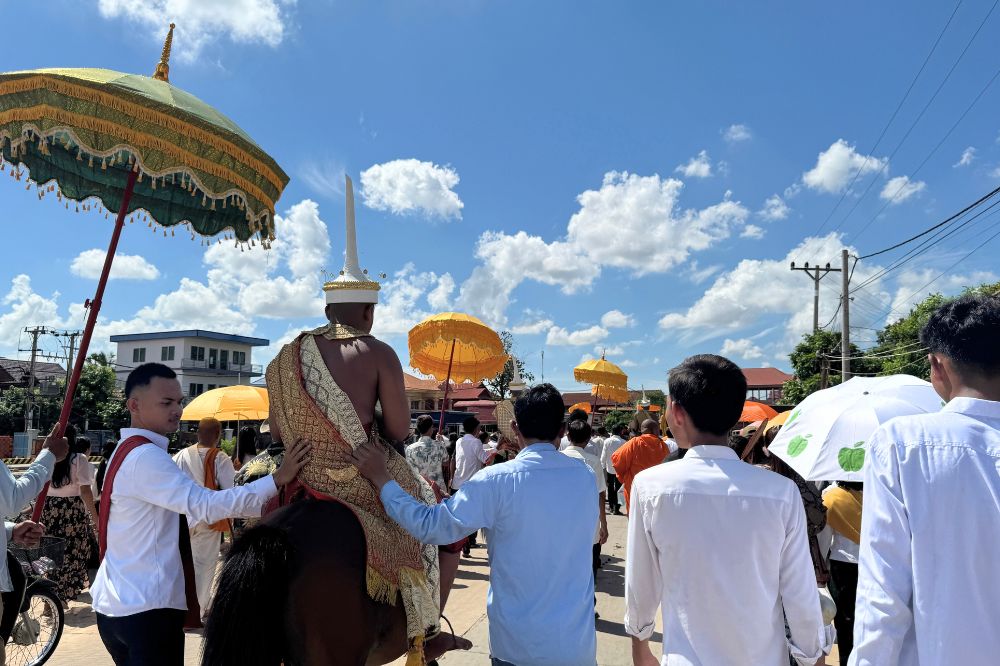
Long before the sun glints off the golden spires of the local village pagoda (wat), the air is filled with the rhythmic pounding of traditional drums and the high-pitched melody of the sralai reed pipe. In rural Cambodia, there is no milestone more profound for a young man—or more deeply emotional for his family—than Buok Buos Neak (បួសនាគ), the sacred ordination ceremony where a young boy or man enters the Buddhist monkhood.
To witness Buok Buos Neak in a Siem Reap village is to step into the beating heart of Khmer Theravada Buddhist culture. It is a colorful, tearful, and joyful community celebration that marks a young man’s transformation into a monk and a protector of his family’s spiritual merit.
The Meaning Behind the Myth: Why Candidates Are Called Neak
Before a young man puts on the iconic saffron robes, he is known as a Neak (Naga)—the mythical serpent spirit of Khmer mythology.
According to Buddhist legend, a shape-shifting Naga serpent once transformed into a human to join the Buddha’s Sangha (monkhood). When the Buddha discovered the serpent’s true identity, he explained that only humans could be ordained. The heartbroken Naga agreed to leave, but requested that all future human candidates be called Neak before their vows to honor its deep devotion.
When a young Cambodian man undergoes Buok Buos Neak, he is stepping into the shoes of that mythical serpent, demonstrating his willingness to shed his secular, worldly skin to pursue spiritual purity.
The Sacred Rituals: A Journey of Humility and Transformation
A traditional village ordination is a multi-day community effort where an entire village gathers to help prepare the candidate.
Family members, starting with the parents and elder relatives, take turns snipping locks of the candidate’s hair into a lotus leaf. Finally, the head and eyebrows are completely shaved. This physical act represents shedding personal vanity, worldly attachments, and ego.
Dressed in white robes symbolizing purity, the candidate is carried through the village on a decorated platform or piggybacked by friends, accompanied by vibrant traditional music. The procession circles the local pagoda three times to pay respect to the Triple Gem (Buddha, Dharma, Sangha).
Parents wash their son’s head with holy water infused with flowers. In a deeply moving moment, the son kneels before his parents to ask forgiveness for any past mistakes, expressing profound gratitude (Khmer filial piety) for their upbringing.
Inside the pagoda’s ordination hall (Vihear), senior monks test the candidate’s readiness in Pali chants. Once approved, the white robes are replaced with holy saffron robes, and he receives his eight basic monastic requisites (alms bowl, robes, belt, razor, needle, filter, and fan).
Generating Merit (Bun) for Parents and Ancestors
Why do young Cambodian men take vows, whether for a few weeks, several months, or a lifetime?
In Theravada Buddhism, ordaining as a monk generates tremendous bun (spiritual merit). Cambodians believe that a son’s monkhood is the highest gift he can give to his mother and father, helping clear their karma and ensuring peaceful rebirths. The mother holds onto the tail of her son’s white robe during processions, symbolically being pulled toward spiritual salvation.
Interested in learning more about Cambodian spiritual traditions?