
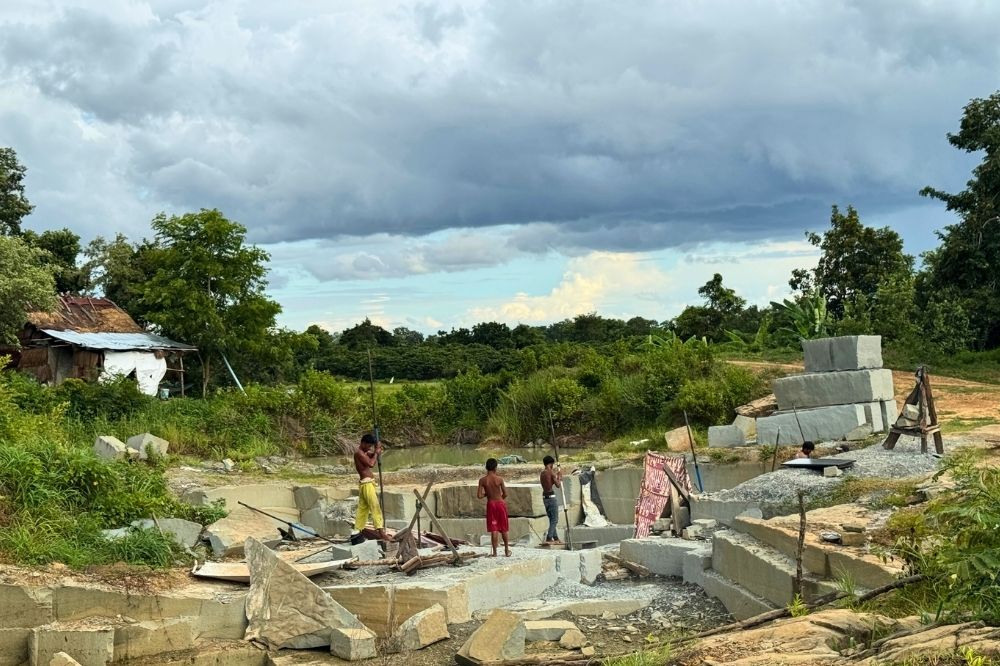
Looking in the mud at the foot of Mount Kulen near Siem Reap, you aren’t just looking at rocks. You are staring directly into the engine room of the Khmer Empire.
During a recent site visit to an ancient quarry, we got up close to the raw materials that built the world’s largest religious monuments—specifically, the dual magic of laterite and sandstone. Watching how these stones were carved offers a whole new level of appreciation for the temples of Angkor.
The Hidden Genius: Why Laterite Built the Core
Most visitors gaze at the outer relief carvings of Angkor Wat, admiring the smooth, pale gray surfaces. But the real heavy lifting happened out of sight, deep inside the foundations.
-
The Transformation: Laterite is a clay-rich soil rock that is soft and porous when dug up underground. Workers cut it easily while wet, but once exposed to sun and air, the iron content oxidizes and hardens into dense, practically indestructible stone.
-
The Foundation: Because it is porous, laterite drains water efficiently without shifting—preventing massive stone towers from sinking into Cambodia’s monsoon-soaked soil.
Why Sandstone Precision Changed Everything?
While laterite formed the structural skeleton, sandstone was the empire’s skin. At the quarry sites, seeing the physical grid marks left by 12th-century chisels reveals why mastering sandstone cutting was a turning point for Khmer civilization: Feature – Engineering Purpose – Architectural Impact. While laterite formed the structural skeleton of the temples, sandstone was the empire’s skin. Carvers specifically cut along the natural grain lines of the sandstone, which prevented giant blocks from splitting under immense vertical weight. They also shaped each block with near-perfect flat edges and ground them together using water and sand; this zero-mortar technique created microscopic seams, providing a smooth, continuous “canvas” for intricate relief carvings. Finally, cutting the stone into uniform rectangular blocks made it easy to pack them tightly onto rafts, drastically speeding up the transport of millions of tons of stone along canals from Mount Kulen straight to the building sites.
Seeing the Qarries Firsthand
Visiting a stone cutting site shifts your perspective entirely. You stop seeing Angkor’s temples as mystical static structures dropped from the sky, and start seeing them as the peak of human trial, error, and architectural precision. Next time you touch the cool walls of Banteay Srei or Angkor Wat, remember: every angle began with a precise chisel strike in the red earth of Siem Reap.