
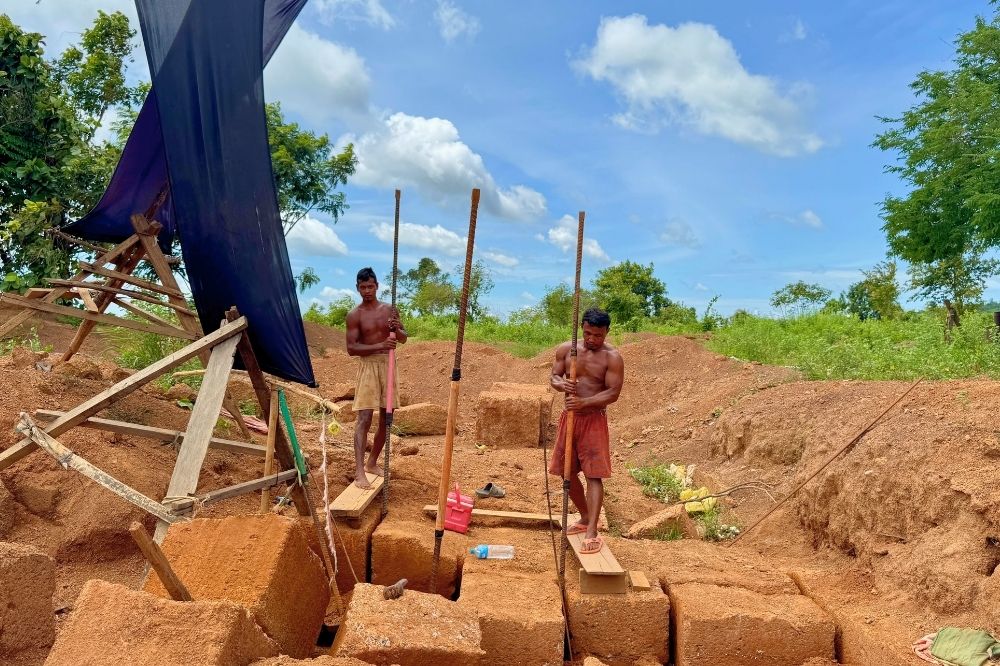
Standing in front of Banteay Srei or looking up at the towering spires of Angkor Wat, it is easy to lose yourself in the delicate surface details—the carved apsaras, the smooth sandstone faces, and the grand bas-reliefs. But if you look deeper, beneath the decorative sandstone skin of every major Khmer temple, you find the true backbone of ancient Siem Reap: laterite stone.
Visiting a laterite quarry site in Siem Reap changes how you view these ancient structures forever. It shifts your perspective from admiring art to respecting sheer human engineering.
What Makes Laterite So Unique?
Laterite isn’t a typical stone carved out of solid mountain rock. It is a soil and rock type rich in iron and aluminum, formed over millennia in tropical climates through intense weathering.
-
Soft Underground, Rock-Hard in Air: When laterite is still underground and saturated with groundwater, it is soft, porous, and clay-like. Quarry workers can slice into it using basic iron tools almost like cutting through cold butter.
-
The Irreversible Harden: Once brought to the surface and exposed to oxygen and the hot sun, the iron minerals oxidize. The stone bakes dry and hardens permanently into a dense, cellular block.
-
“Grilled Rice” Texture: Locals often call it baï kriem (literally “grilled rice”) because of its pitted, honeycombed appearance.
The Labor Behind the Beauty
Understanding the stone-cutting process reveals the intense physical effort invested before a single temple wall was raised:
-
Manual Extraction: Ancient masons dug down into the wet subsoil, cutting deep parallel grooves around rectangular blocks using iron picks and wedges.
-
Curing: The blocks had to be brought out and left to air-cure until they hardened enough to bear heavy structural weight.
-
Transport & Placement: Because of its high iron content, cured laterite is extremely heavy. Moving thousands of these blocks required network systems of canals, wooden rollers, and draft animals long before modern machinery existed.
Sandstone gave the Khmer Empire its beauty, but laterite gave it longevity. Laterite was used for deep foundations, massive city enclosure walls, courtyard paving, and inner temple cores because it absorbed water and withstood the tropical monsoon shifts without collapsing.
When you stand in a quarry, looking at the carved-out earth where blocks were extracted hundreds of years ago, the grand temples stop looking like magical monuments. You begin to see them for what they truly are: millions of hours of human willpower, sweat, and clever material science.