
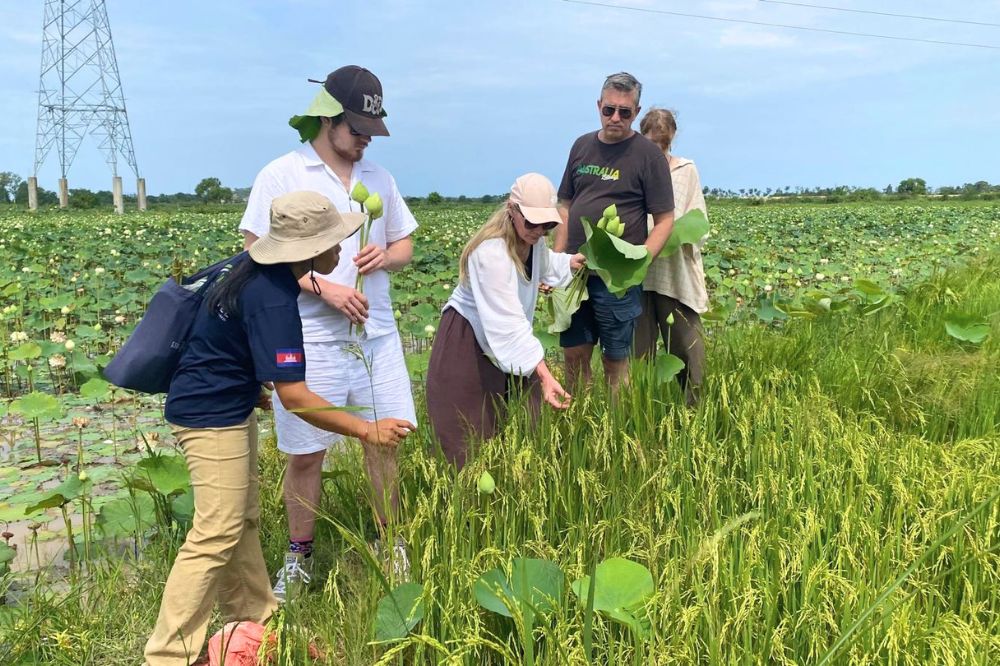
If you stand in the countryside of Kampong Thom or Battambang during the rainy season, you will see an endless sea of vibrant green stretching out to meet the horizon. Look a little closer, and you’ll see the reflection of the sky in shallow water, ancient sugar palms rising up like sentinels, and families working rhythmically in the paddies.
In Cambodia, rice is far more than an agricultural commodity. It is wrapped into the nation’s culture, daily survival, economy, and spiritual identity. The local Khmer language even reflects this deep bond: the word for eating food, pisa bay, literally translates to “eat rice.” You can’t have a meal without it, and you certainly can’t understand Cambodia without understanding its paddies.
So, how important is rice farming in Cambodia? Let’s take a deep dive into the historical roots, economic power, cultural heartbeat, and modern challenges facing Cambodia’s most vital crop.
1. The Economic Engine: Feeding Millions and Fueling Growth
Rice farming isn’t just a traditional lifestyle—it’s a multi-billion-dollar economic pillar. The agriculture sector as a whole contributes roughly 16% to Cambodia’s Gross Domestic Product (GDP), with paddy rice taking up the lion’s share of cultivated land—roughly 3.8 million hectares across the country according to the Fresh News Article ( While much of the harvest is kept by smallholders to feed their own families (ensuring domestic food security), Cambodia produces a massive surplus. The country harvests over 14 to 15 million metric tons of paddy rice annually, leaving millions of tons available for processing and trade.
2. Global Recognition: The World’s Best Fragrant Rice
For a long time, neighboring giants like Thailand and Vietnam dominated the international narrative on Southeast Asian rice. However, Cambodia has quietly built a global reputation for premium quality, specifically with its premium fragrant varieties like Phka Rumduol (jasmine rice) and Sen Kra-op. Cambodian Phka Rumduol has won the prestigious “World’s Best Rice” title multiple times at the World Rice Conference.
What makes Cambodian fragrant rice special?
-
Organic Practices: Many smallholder farmers still rely on traditional, low-chemical farming methods.
-
Unique Ecosystems: The rich sediment deposits from the annual flooding of the Tonle Sap Lake create fertile soils that impart a distinct floral aroma and soft texture to the grain.
-
Strict Quality Control: Modern mills and exporter federations have modernized testing and packaging to meet strict EU, Chinese, and US import standards.
Today, Cambodia exports close to 1 million tons of milled rice annually to more than 60 countries, earning hundreds of millions of dollars in foreign exchange.
3. Culture and Daily Life: More Than Just Food
To understand the social weight of rice, you have to look at the rhythm of rural life. The Cambodian calendar is fundamentally shaped by the monsoon and the paddy fields.
-
The Royal Plowing Ceremony (Preah Reach Pithi Chrot Preah Nongkoal): Every May, the royal family leads an ancient ritual using sacred oxen to predict the upcoming harvest, rainfall, and crop yields. It signals to farmers that it is time to prepare their fields.
-
Ancestors’ Day (Pchum Ben): During this 15-day religious festival, Cambodians offer sticky rice balls (Bay Ben) to Buddhist monks to dedicate merit to their ancestors.
-
Community & Solidarity: Planting and harvesting season traditionally relied on provas—a community exchange where neighbors gathered to help farm each other’s plots in turn, cementing village bonds.
4. The Ecological Wonder: Tonle Sap and the Floodplain
You cannot talk about Cambodian rice without talking about the Tonle Sap Lake—the beating hydrological heart of the country.
During the wet season, the Mekong River swells with snowmelt and monsoon rainfall, forcing the Tonle Sap River to reverse its flow. This pushes water backward into the Tonle Sap Lake, expanding it up to five times its dry-season size.
When the floodwaters recede in the dry season, they leave behind millions of tons of nutrient-dense silt across surrounding provinces like Battambang, Siem Reap, Pursat, and Kampong Thom. This natural irrigation system creates ideal conditions for deep water floating rice and high-yield dry season paddy cultivation, minimizing the need for heavy chemical fertilizers.
5. Modern Challenges in the Rice Sector
Despite its historical success, Cambodian rice farming stands at a critical crossroads. Smallholder farmers face significant hurdles that threaten their stability:
Climate Volatility
Unpredictable monsoon seasons, extended droughts caused by El Niño, and sudden flash floods hit rural farmers hard. Because many plots lack modern irrigation systems, they remain dependent on natural rainfall.
High Production & Processing Costs
Cambodian farmers often pay higher prices for electricity, fuel, and logistics compared to their neighbors in Vietnam or Thailand. Additionally, a large portion of raw paddy is sold directly across borders as unprocessed grain due to a lack of local high-capacity drying and milling facilities.
Rural-to-Urban Migration
As younger generations move to Phnom Penh for garment industry jobs or migrate abroad for work, rural villages face labor shortages during planting and harvesting seasons, accelerating the need for expensive farm machinery.
6. The Future: Tech, Climate Resilience, and Agribusiness
To safeguard the future of its “white gold,” Cambodia is modernizing its agricultural landscape:
-
Modern Agricultural Communities: The government has deployed thousands of agricultural experts directly into local communes to help farmers form cooperatives, pool resources, and secure fair market prices.
-
Climate-Smart Irrigation: Solar-powered water pumps and controlled canal networks are reducing dependency on unpredictable rains.
-
Organic Certification: Exporters are positioning Cambodian rice as a premium organic brand in eco-conscious European and North American markets.
Rice farming in Cambodia isn’t just about preserving history—it is about innovating for a sustainable future. It nourishes the nation, supports millions of families, and proudly carries the Cambodian identity onto the global stage.