
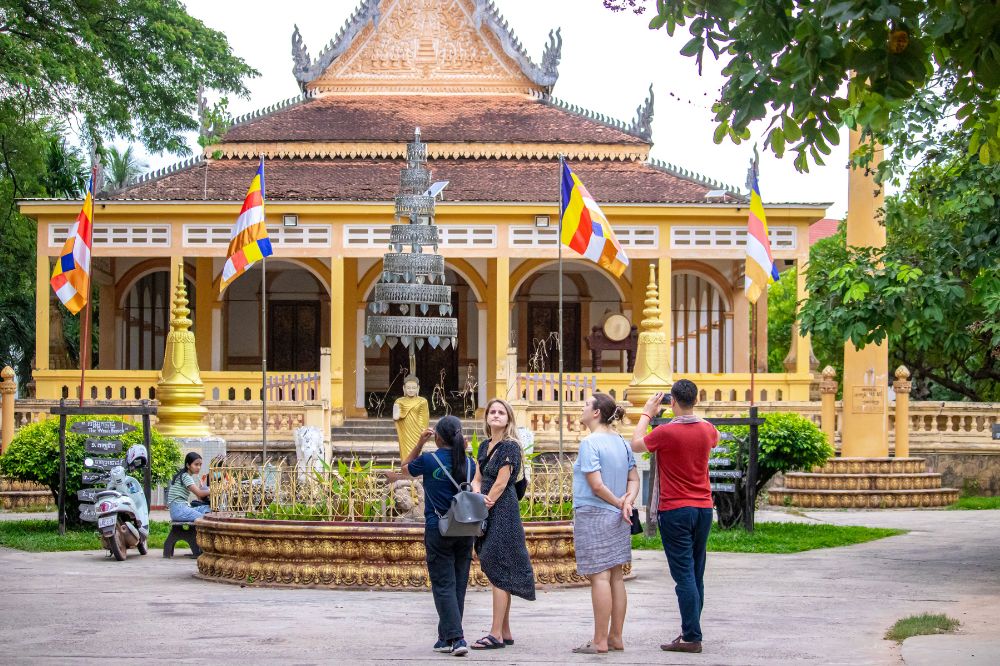
If you wake up early enough in any Cambodian town or village, just as the sky turns a soft indigo, you’ll witness a quiet, beautiful rhythm. A line of monks in vibrant saffron-colored robes walks silently down the road. Local shopkeepers and families step out of their homes, barefoot, with dishes of warm steamed rice or fresh fruit. They quietly bow their heads, place their offerings into the monks’ bowls, and receive a short, whispered chant of blessing in return.
No fanfare. No loud announcements. Just an effortless, daily exchange of grace.
In Cambodia, Theravada Buddhism isn’t just a religion you practice on Sundays or visit during annual holidays. It is the invisible cultural operating system running in the background of everyday life. Practiced by over 95% of the population, Buddhism defines how people speak, greet each other, handle conflicts, celebrate, mourn, and view their place in the universe.
So, how deeply does Buddhism influence the daily behavior and mindset of the Khmer people? Let’s take a walk through Cambodian homes, streets, and minds to find out.
1. The Core Philosophy: Karma, Rebirth, and Bun (Merit)
To understand Khmer behavior, you first have to understand Karma (Kamma) and Merit-making (Thwer Bun).
In Western culture, people often view karma as a cosmic system of punishment: “What goes around, comes around.” In Cambodian culture, however, it is viewed much more constructively—it’s an encouraging law of cause and effect. Good actions produce good outcomes; bad actions bring hardship. THE CIRCLE OF MERIT (THWER BUN) start with Generosity / Kindness —> Accumulate Merit (Bun) —> Good Health & Fortune —> Harmonious Society continuedly.
This leads directly to the concept of Thwer Bun (making merit). Cambodians believe that every act of kindness, every donation to a temple, and every bowl of rice given to a monk accumulates spiritual capital that brings peace in this life and a better rebirth in the next.
How this shapes daily behavior:
-
Radical Generosity: Sharing food is second nature. If you visit a rural Khmer home, even if the family has very little, they will immediately offer you tea, fruit, or whatever meal they are cooking.
-
Respect for Elders: Caring for aging parents isn’t viewed as a burden; it is one of the highest merit-making opportunities a child can have.
-
Calm Acceptance (Aksel): When facing unfortunate events—a rainy season crop failure, a broken motorcycle, or a missed opportunity—you’ll often hear Cambodians gently say “Chhoeu Kbal” (don’t overthink it) or acknowledge it as past karma. This creates a remarkable emotional resilience and patience in the face of hardship.
2. Social Etiquette: Body Language as Sacred Space
Walk down a street in Phnom Penh or Siem Reap, and you’ll notice that Khmer interactions carry a distinct softness. This physical gentle behavior is rooted straight in Buddhist teachings about humility, awareness, and avoiding emotional harm (Ahimsa).
THE KHMER SAMPEAH HIERARCHY
- Level 1: Chest —> Friends and peers
- Level 2: Mouth —> Bosses, elders, and superiors
- Level 3: Nose —> Parents, teachers, and grand-parents
- Level 4: Eyebrows —> Monks and the King
- Level 5: Forehead—> Buddha and sacred objects
The Sampeah Greeting
Instead of a firm handshake, Cambodians press their palms together in front of their chest and bow slightly—a gesture known as the Sampeah. The position of your hands shifts depending on the spiritual or social hierarchy of the person you’re greeting. Raising your hands higher to greet a monk or an elder is a direct physical expression of Buddhist humility.
Rules of the Body
Buddhism teaches that the human body is symbolically ordered:
-
The Head is Sacred: The head is considered the highest, purest part of the body, where spirit resides. Touching someone’s head—even playfully ruffling a child’s hair—is considered deeply disrespectful.
-
The Feet are Low: Feet are considered spiritually unclean. Cambodians will never point their feet at another person, and especially never toward a Buddha statue or a monk. When sitting on the floor in a temple or home, men sit cross-legged while women tuck their legs neatly to the side.
3. Emotional Control: Avoiding Koa-say (Anger) and Saving Face
If there is one thing that shocks first-time visitors to Cambodia, it is how rarely you see someone lose their temper in public. Raising your voice, slamming a fist, or screaming in anger is considered a massive personal failure in Khmer society.
Buddhism identifies Anger (Dosa) as one of the three primary poisons of the mind (alongside Greed and Delusion). To lose your cool is to show that you have zero control over your mind.
Key Rule of Interaction: Losing your temper doesn’t show authority; it makes you lose respect immediately. A calm, smiling demeanor—even during a heated disagreement—is considered the ultimate sign of strength and wisdom.
This philosophy explains the famous Khmer Smile. A smile in Cambodia isn’t always an expression of pure happiness; it can be a polite way to defuse tension, soften bad news, apologize for a mistake, or preserve harmony in a room.
4. The Pagoda (Wat) as the Social Ecosystem
In Western countries, a church or temple is often used primarily for religious services. In Cambodia, the Wat (Buddhist monastery) is the physical and emotional center of every single community.
Historically, before modern government infrastructure existed, the Wat was the local school, hospital, community center, shelter, and retirement home all wrapped into one. Even today, in rural areas, the Wat remains the central hub of daily life.The Wat’s Daily Role:
-
Social Safety Net: If an underprivileged young boy from a rural province wants to study at a university in the city, he will often live at the local pagoda as a Sramon (monk) or pagoda boy, receiving free housing and food while pursuing his education.
-
Conflict Resolution: When family disputes or land arguments happen in villages, people often consult the senior head monk (Chao Athikar) before going to legal courts. A word of gentle wisdom from a respected monk carries immense moral authority.
-
Festival Gatherings: Major national holidays like Pchum Ben (Ancestors’ Day) and Khmer New Year (Choul Chnam Thmei) revolve around families gathering at their local pagodas to eat, pray, decorate, and strengthen social bonds.
5. Rites of Passage: From Childhood to Elderhood
Buddhism frames the milestones of a Cambodian’s life from birth to death, offering comfort and structure at every stage.
Temporary Ordination (Thwer Preah)
It is a time-honored tradition for young Cambodian men to be ordained as monks for a short period—ranging from a few weeks to several months—usually in their late teens or early twenties.
This isn’t necessarily a commitment to a lifelong monastic life. Instead, it is seen as a crucial rite of passage into manhood. It teaches self-discipline, meditation, and Buddhist ethics. Most importantly, entering the monkhood is considered the ultimate gift of merit a son can offer to his mother and father to thank them for raising him.
Funeral Rites and Letting Go
Because Buddhism views death not as an end, but as a transition to a new existence, Cambodian funerals are solemn yet communal and hopeful.
Bodies are cremated rather than buried, symbolizing the release of the spirit from its physical form. Family members wear white (the traditional color of mourning in Cambodia) and gather at the pagoda over several days to perform merit-making ceremonies, ensuring their loved one’s soul transitions smoothly into a favorable rebirth.
6. Modern Evolution: Buddhism in a Fast-Changing World
As Cambodia rapidly modernizes—with high-rises climbing in Phnom Penh, high-speed internet reaching remote villages, and coffee shops popping up on every corner—how is Buddhism holding up?
While younger generations of Cambodians may spend less time sitting in long meditation sessions than their grandparents, the underlying principles remain remarkably intact. You’ll see tech workers in Phnom Penh stop by a shrine before a big job interview, young couples wearing blessed red string bracelets on their wrists for good luck, and drivers bowing to roadside Buddha shrines on their morning commutes.
Buddhism in Cambodia isn’t a rigid, dusty book of rules. It is a living, breathing lifestyle of kindness, emotional balance, and community solidarity that keeps the country grounded through rapid change.