
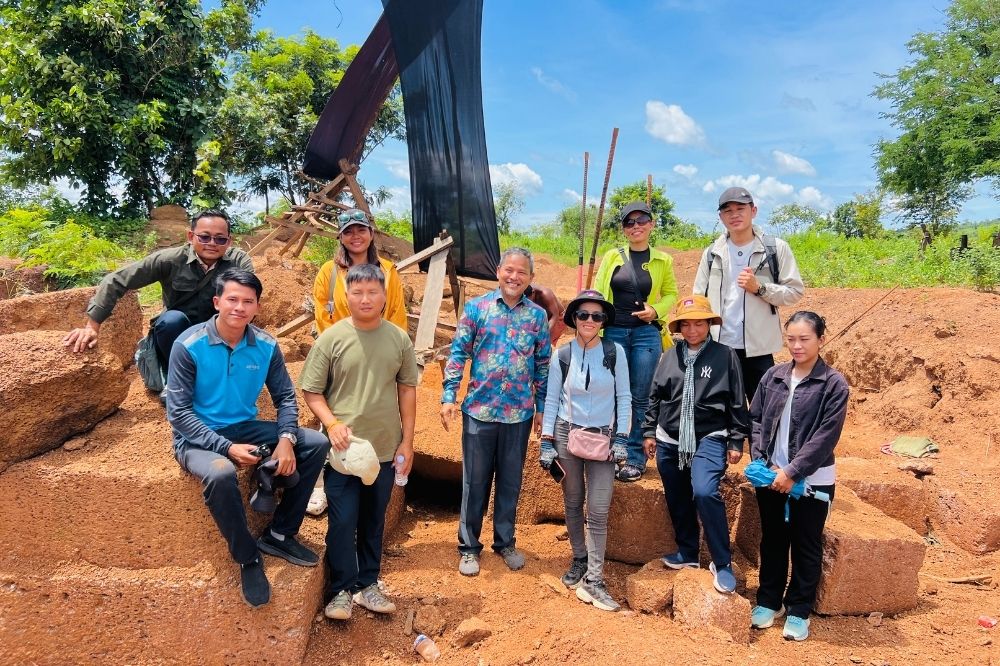
Date: August 22, 2026 – Location: Siem Reap, Cambodia
When standing in front of Siem Reap’s majestic ancient temples, it is easy to focus entirely on the final masterpiece—the intricate carvings, massive towers, and grand bas-reliefs. But on our site visit on August 22, 2026, we looked beneath the surface by visiting a local quarry site to explore how these iconic structures were built from the ground up.
To truly appreciate Khmer architecture, you have to understand the invisible backbone of every temple: laterite stone and sandstone, and the sheer human effort required to extract them.
The Magic of Laterite: Soft in the Earth, Hard in the Sun
Laterite is a unique, iron-rich clay rock formed through millions of years of intense weathering in tropical climates. What makes laterite so fascinating—and essential to ancient builders—is its natural transformation:
-
In the ground: It is soft, moist, and porous. Builders could easily cut it into neat rectangular blocks using simple hand tools.
-
Exposed to air: Once quarried and exposed to oxygen and sunlight, the iron oxidizes. The stone bakes permanently hard, turning into a durable, weather-resistant reddish-brown block.
Because of its strength, ancient artisans used laterite for hidden foundations, inner core walls, and surrounding enclosure dikes.
Laterite vs. Sandstone: The Perfect Architectural Partnership
Khmer master builders paired laterite with sandstone to balance strength with beauty: Feature: Primary Role – Material Trait – Extraction Location.
- Laterite Stone: Structural core, foundation, Porous, iron-heavy, hardens after cutting, Quarried locally near ground level.
- Sandstone: Facade, detailed reliefs, intricate carvings, Fine-grained, smooth, easy to carve detailed art, Transported from Mount Kulen miles away.
Why Understanding the Process Matters
When you look at a temple wall today, you aren’t just looking at stone; you are looking at millions of hours of physical labor.
Ancient workers had to cut each block by hand without modern machinery, transport thousands of tons across rivers and dirt paths, and fit them together without mortar.
Seeing the quarry site transforms how you experience a temple tour. You move past simply calling a building “beautiful” and begin to grasp the engineering genius, geological understanding, and immense human sacrifice behind every single block standing in Siem Reap today.